
Introduction: The New Global Paradigm of Battery Transparency
The global surge in the adoption of electric vehicles (EVs) and stationary energy storage systems has placed the battery at the very heart of the world’s clean energy transition. This exponential growth, projected to continue for decades, necessitates a profound paradigm shift away from a linear « take-make-dispose » model toward a sustainable, circular one. While a number of nations and regional blocs are developing policies to manage this transition, the European Union’s new Batteries Regulation (EU 2023/1542) stands as the most comprehensive legislative framework to date, with the Digital Battery Passport (DBP) as its central, digital enabler. This report provides an in-depth analysis of this regulation, its key components, and its far-reaching implications, while also presenting a critical comparison to the established, yet philosophically distinct, system in China.
The Digital Product Passport (DPP), in its various forms, is not a stand-alone policy; it is a technological instrument designed to enforce a broader legislative framework. The fundamental significance of this approach lies in its capacity to transform a physical product’s lifecycle into a verifiable digital record. This marks a new era of proactive regulation where a « digital twin » is used to manage and ensure the environmental and social integrity of a physical product’s journey through a global supply chain. By creating a persistent and auditable digital history for each individual battery, the EU aims to extend its regulatory reach far beyond its own borders, influencing manufacturing and sourcing practices across the globe.
Part I: The EU’s Digital Battery Passport Explained
1.1. A Digital Identity for Every Battery: What and Why
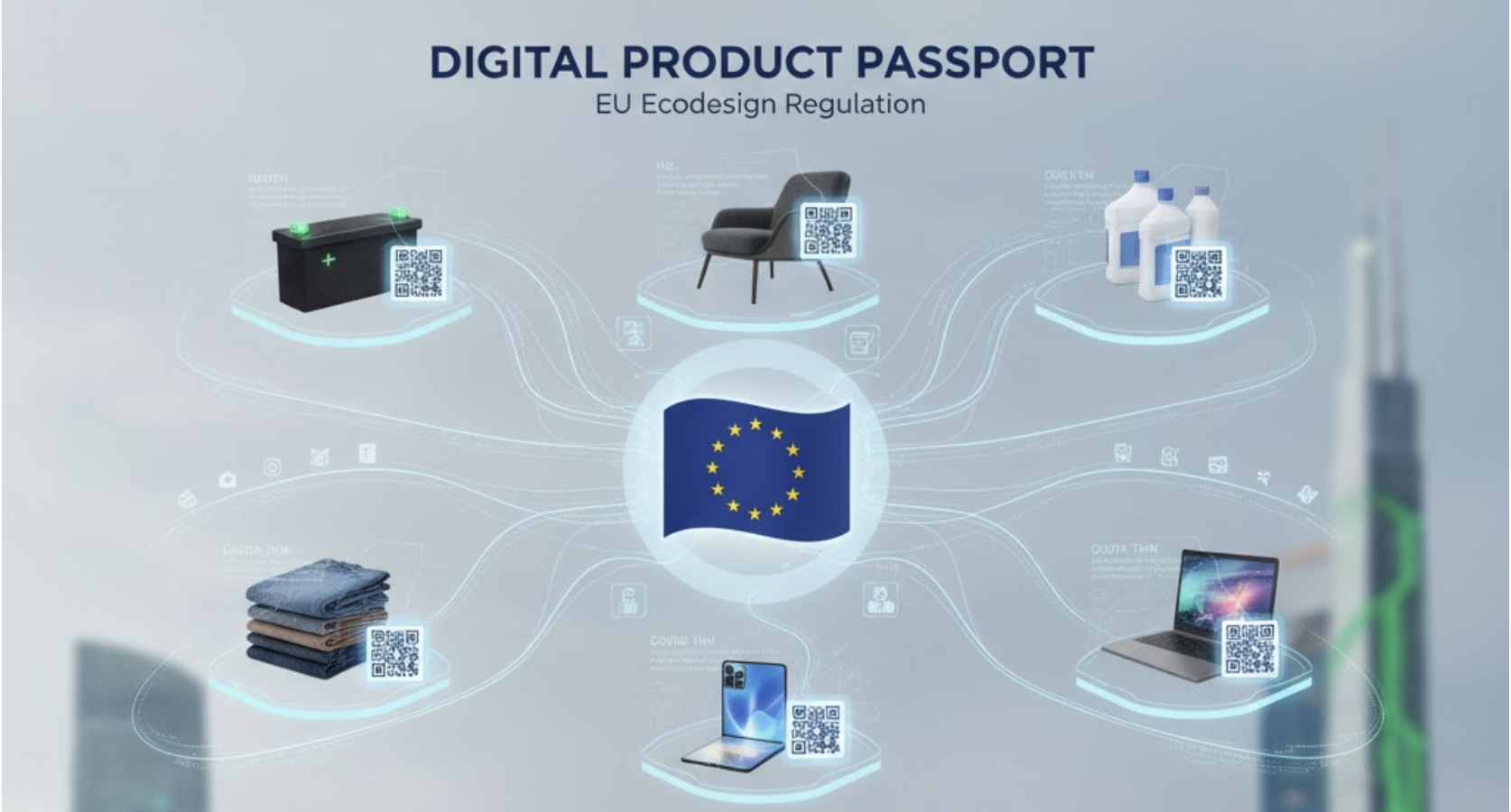
The Battery Passport is a comprehensive digital record that accompanies a battery throughout its entire life cycle, from the initial sourcing of raw materials to its end-of-life recycling and repurposing. It is not a generic document; it is a highly specific implementation of the broader Digital Product Passport (DPP) initiative laid out in the Ecodesign for Sustainable Products Regulation (ESPR). The passport will be accessible to all stakeholders via a unique digital identifier, such as a QR code or an RFID tag, which will be physically printed or engraved on the battery itself.
The core function of this system is to serve as a hub for aggregating and sharing data among all participants in the value chain, including manufacturers, consumers, recyclers, and regulators. This unprecedented level of transparency is intended to serve several legislative goals beyond mere compliance. The overarching objective is to foster a circular economy by providing verifiable data on material composition, durability, and end-of-life options, which facilitates crucial activities like repair, reuse, remanufacturing, and recycling. This shifts the industry’s economic model away from waste creation and toward value retention, as downstream actors will possess the critical information needed to properly handle and process batteries.
Furthermore, the passport is a tool to enhance transparency and accountability across complex, global supply chains. It mandates that supply chain due diligence policies for environmental and social risks—such as the use of child labor or exploitative working conditions—be verifiable and publicly available. This holds companies accountable for their sourcing practices, regardless of the geographic origin of their materials. Finally, the regulation is a strategic move to strengthen Europe’s autonomy and reduce its dependency on foreign imports of critical raw materials. By mandating information on recycled content and promoting the recovery of valuable materials like cobalt, lithium, and nickel, the EU aims to create a self-sufficient, localized ecosystem for its battery industry.
The EU’s approach is fundamentally a « twin transition, » where physical product requirements are integrated with digital data management systems. The Batteries Regulation mandates not only data reporting via the DPP but also imposes physical design changes, such as the requirement for portable batteries to be removable and replaceable by the end user. The DPP then provides the essential « how-to » instructions, including disassembly diagrams and required tools, to enable this process. This dual-pronged strategy suggests a clear understanding that a digital solution alone is insufficient. The EU recognizes that real-world problems—such as waste, pollution, and resource depletion—require a combination of legislative force on physical design and informational transparency to empower new, circular business models. The causal relationship is clear: a legislative goal to foster circularity leads to mandated physical product design changes and digital data requirements, which in turn empower stakeholders like repair shops and recyclers, ultimately leading to a more realized circular economy.
1.2. The Countdown to Compliance: A Phased EU Timeline
The EU Batteries Regulation’s implementation is a phased, multi-year process designed to provide the industry with a clear, but challenging, roadmap for compliance. The approach is not a sudden mandate but a deliberate, strategic deployment of new rules over time, allowing businesses to adapt their operations and supply chains.
The regulation officially entered into force on August 17, 2023, and will fully repeal the old Batteries Directive (2006/66/EC) on August 18, 2025. The first major compliance milestone took place on February 18, 2025, when mandatory carbon footprint reporting began for electric vehicle (EV) batteries. This requirement will be expanded to other battery types in subsequent years. Following this, August 18, 2025, marks the date when key provisions on waste battery management become mandatory, including the requirement for producers to register in each EU Member State where they place batteries on the market. New rules for calculating and verifying recycling efficiency and material recovery will also enter into force on this date.
The most significant deadlines for the Digital Battery Passport are still to come. The DBP itself becomes mandatory on February 18, 2027, for all EV batteries, industrial batteries with a capacity exceeding 2 kWh, and Light Means of Transport (LMT) batteries. Separately, the due diligence obligations for supply chains, which were initially scheduled for 2025, have been postponed until August 18, 2027. This postponement is not a sign of regulatory weakness, but a pragmatic adjustment to feedback from industry stakeholders. Securing a ten-year record of supply chain transparency and establishing third-party verification processes is a massive undertaking. By moving the deadline, the EU ensures that the groundwork for data collection—including carbon footprinting and performance data—is in place before the full due diligence obligation takes effect, allowing companies a clear window to prepare for these inevitable and non-negotiable mandates. Looking further ahead, mandatory recycled content documentation will be required from August 18, 2028 , with legally binding minimum recycled content targets coming into effect on August 18, 2031, and a second, higher set of targets applying from August 18, 2036.
This phased timeline demonstrates a deliberate, strategic regulatory approach designed to manage the immense complexity and cost of compliance, while also signaling a long-term and unwavering commitment to the regulation’s objectives.
EU Battery Regulation & Passport Key Timeline
| Date | Obligation |
| August 17, 2023 | New Batteries Regulation enters into force. |
| February 18, 2025 | Mandatory carbon footprint reporting begins for EV batteries. |
| August 18, 2025 | Old Batteries Directive is repealed. Waste battery management obligations begin. |
| August 18, 2026 | General labeling requirements for batteries take effect. |
| February 18, 2027 | Digital Battery Passport becomes mandatory for EV, industrial (>2 kWh), and LMT batteries. |
| August 18, 2027 | Due diligence obligations for supply chains become mandatory. |
| August 18, 2028 | Mandatory documentation of recycled content begins. |
| August 18, 2031 & 2036 | Minimum recycled content targets become legally binding. |
1.3. The Passport’s Composition: Mandatory Data and Role-Based Access
The Digital Battery Passport is far more than a simple data label; it is a comprehensive repository of both static and dynamic information. The mandatory data points are grouped into several critical categories that collectively provide a full-lifecycle digital history for each battery.
First, General & Identification Information provides the fundamental product identity. This includes a unique battery identifier for traceability, manufacturer details, the place and date of manufacture, and physical specifications such as weight and dimensions.
Second, Supply Chain & Sustainability Data forms a core element of the regulation. It requires verifiable information on the sourcing of raw materials, the carbon footprint of the battery, and the percentage of recycled materials used. The carbon footprint must be drawn up per battery model and manufacturing plant, and the declared value must remain below a maximum life cycle threshold to be established by the Commission.
Third, Performance & Health Data is a critical, dynamic component that differentiates the DBP from traditional data repositories. The passport must be continuously updated throughout its lifecycle with information on the battery’s State of Health (SoH), State of Charge (SoC), capacity, expected lifetime, and the number of charging and discharging cycles. This requirement fundamentally changes the technological demands on manufacturers, necessitating a move beyond static data sheets to integrated, real-time data systems. A traditional product database can store static information like the manufacturing date and material composition, but it cannot track a battery’s SoH or number of charge cycles, as this data is generated dynamically during the product’s use phase. Therefore, compliance requires manufacturers to connect their products to a cloud-based or blockchain-based data management system that can receive and process this dynamic data throughout the battery’s operational life. This ripple effect necessitates massive, system-wide investment in IT infrastructure and data collection processes.
Finally, End-of-Life & Circularity Information must be included to facilitate responsible handling. This includes detailed guidelines for repurposing, remanufacturing, and recycling, as well as instructions for disassembly and the specific tools required for the process. The passport must also specify how to safely handle any hazardous substances within the battery.
To address concerns over data privacy and the protection of proprietary information, a key feature of the DBP is its tiered, role-based access system. The general public can access basic information via a QR code on the battery or its packaging, including recycling instructions, basic product details, and locations for collection schemes. However, more granular data, such as detailed composition, part numbers for replacement spares, and specific safety measures, is restricted to « need-to-know » parties like recyclers, independent repair professionals, and regulatory authorities. This system balances the need for transparency with the need to protect sensitive business information.
Part II: The View from the East: China’s Parallel System
2.1. China’s Centralized Traceability and Recycling Framework
While the EU’s DBP is a global first in its specific, comprehensive form, China has been a pioneer in mandatory battery traceability for years. Recognizing the scale of its burgeoning EV market, the country introduced the GB/T 34014 standard in 2017, establishing a mandatory alphanumeric traceability code for EV batteries. The system was officially implemented in 2018, several years before the EU’s 2027 deadline.
The Chinese system is a centralized, state-driven tool for managing a massive domestic EV market and proactively addressing the anticipated « wave of EV battery retirements ». The data is reported to a national platform managed by the Ministry of Industry and Information Technology (MIIT). The required data fields are focused on a standardized, static traceability code that includes a manufacturer code, product type code, battery type, and a unique serial number. This system is primarily a tool for industrial policy and resource management, prioritizing supply chain control and the scaling of its domestic recycling industry over the EU’s emphasis on public transparency and consumer-facing data. The government’s « whitelisting » of recycling companies and its aggressive recovery targets for materials like lithium (90%) and nickel (98%) are clear indicators of a top-down, planned economy approach. This is in direct contrast to the EU’s market-based model, where the DPP is a horizontal requirement for all market players, regardless of origin, to compete on the basis of sustainability and transparency.
2.2. A Critical Regulatory Divergence: The Case of « Black Mass »
One of the most significant policy divergences between the EU and China, with profound commercial and geopolitical implications, is the classification of « black mass. » This is the intermediate material that results from the initial shredding and hydrometallurgical processing of end-of-life lithium-ion batteries and battery manufacturing scrap. It contains a high concentration of critical raw materials such as cobalt, nickel, and lithium.
The EU has classified black mass as a hazardous waste. This classification requires strict and costly handling, transport, and processing within the EU’s borders, creating a significant logistical and economic burden for domestic recyclers. In stark contrast, China has classified black mass as a non-waste (provided it meets certain quality standards) and, as of August 2025, is lifting its import ban on the material.
China’s black mass policy represents a highly strategic move to secure its dominance in the global battery value chain by leveraging its vast refining capacity. China currently has over 85% of the world’s black mass refining capacity, with a significant portion of it lying idle. By reclassifying the material as non-waste and opening its borders to imports, China can absorb recycled battery materials from around the world—including from the EU—and process them into high-value critical minerals. This policy reinforces the country’s central position in the global battery supply chain. The EU’s policy, while seemingly a step toward environmental protection, could inadvertently create a supply chain vulnerability, potentially resulting in European black mass being exported to China, thus undermining the EU’s stated goal of strategic autonomy.
Part III: Comparative Analysis and Strategic Implications
3.1. EU vs. China: A Tale of Two Philosophies
The EU and Chinese systems for battery traceability and management represent fundamentally different philosophies of governance and industrial policy. The EU is driven by overarching goals of sustainability, human rights, and circularity , while China is primarily driven by industrial policy, supply chain control, and resource security for its massive domestic market.
The EU’s DBP is envisioned as a decentralized, interoperable system with tiered access for various stakeholders, from consumers to regulators. The data model is comprehensive and full-lifecycle, including dynamic data on performance, carbon footprint, and due diligence on social and environmental risks. In contrast, China’s system is a centralized, state-controlled database with access for government authorities and specific « whitelisted » companies. The scope of data is focused on a static traceability code for safety and recycling management, without the broader environmental and social metrics of the EU’s system. The EU’s implementation is a pilot project pushing a new, complex data infrastructure , whereas China’s is a mature, long-established standard that leverages its existing industrial and administrative structures.
This comparison highlights the core differences in approach: the EU’s focus on transparency versus China’s focus on control. This philosophical divergence has profound implications for global companies operating in both markets.
EU-China Battery Traceability & Policy Comparison
| Feature | European Union (EU) | China |
| Regulatory Driver | Sustainability, circularity, human rights, and strategic autonomy. | Industrial policy, supply chain control, and resource security. |
| System Type | Decentralized, interoperable Digital Product Passport (DPP) with tiered access. | Centralized, state-controlled database via a national platform (MIIT). |
| Data Model & Access | Tiered access: public (via QR code) and restricted to professionals and regulators. | Centralized access for government authorities and approved companies. |
| Scope of Data | Comprehensive, full-lifecycle data including dynamic performance, carbon footprint, and due diligence. | Static alphanumeric traceability code for safety and recycling management. |
| Due Diligence Mandates | Mandatory, third-party verified, and publicly available policies on social and environmental risks. | No explicit due diligence mandates; managed via a state-controlled « whitelist » of companies. |
| Recycled Content Targets | Mandatory minimum recycled content targets for new batteries from 2031. | Recovery rates and recycling infrastructure standards are enforced for « whitelisted » companies. |
| Black Mass Classification | Classified as a hazardous waste, requiring strict handling and processing. | Classified as a non-waste (if it meets standards); imports will be allowed from August 2025. |
3.2. Strategic Recommendations for a Global Industry
Global manufacturers and importers face the unique challenge of complying with two fundamentally different, and at times contradictory, regulatory frameworks. Companies cannot simply use one system for all markets; they must implement a dual strategy to navigate both a decentralized, transparent European market and a centralized, state-controlled Chinese one.
Compliance with the EU’s DPP should not be viewed merely as a regulatory hurdle but as a strategic opportunity. Companies that invest early in robust data management systems and transparent supply chains can gain a significant competitive advantage. By leveraging the data from the DPP, businesses can offer verifiable sustainability claims, which differentiates their products and builds consumer trust. The rich, dynamic data can also enable new circular business models, such as resale, repair services, and the recapture of value from end-of-life materials, unlocking new revenue streams and strengthening supply chain security. Early adoption also mitigates future risk, as it positions businesses as leaders who are already prepared for the inevitable expansion of DPP requirements to other product categories.
For companies seeking to navigate this dual compliance burden, several strategic recommendations are critical. First, it is essential to conduct a comprehensive data audit to identify gaps in data collection, especially for dynamic performance data, carbon footprint, and material origin information. Second, businesses should invest in collaborative technology, such as traceability software and Product Information Management (PIM) systems, that can standardize data across complex supply chains and enable secure data sharing. Third, it is crucial to establish clear processes for engaging with suppliers to collect structured data, as many upstream actors may be unfamiliar with these requirements. Finally, companies must remain agile and continuously monitor the delegated and implementing acts issued by the EU Commission, as these will provide the fine-grained details necessary for compliance.
Conclusion: The Race for a Transparent and Circular Future
The EU’s Digital Battery Passport is not a minor policy; it is a transformative legislative tool that sets a new global benchmark for transparency and circularity in the battery value chain. It forces a fundamental re-evaluation of product lifecycles and supply chain management. While China’s established traceability system provides a strong foundation for its industrial ambitions, the philosophical divergence between the two frameworks—particularly on issues like the classification of black mass—highlights the competing visions for the future of the global battery supply chain.
For any company operating in the global battery sector, compliance is no longer a localized issue. It requires a cohesive, data-driven strategy that can navigate the distinct demands of both a decentralized, transparent European market and a centralized, state-controlled Chinese one. The race for a sustainable future for batteries is underway, and its outcome will be determined not only by technological innovation, but also by the ability of regulatory and commercial actors to create a truly transparent and circular value chain.





Laisser un commentaire