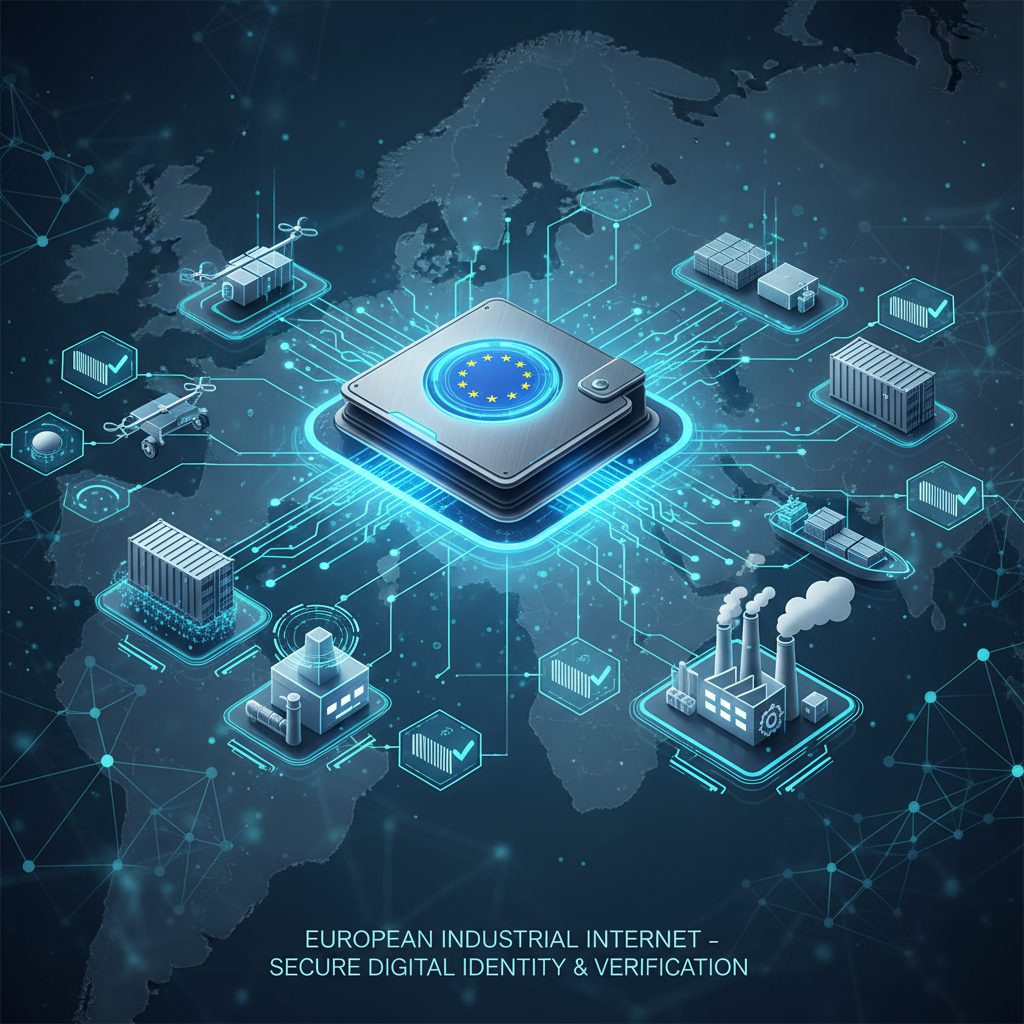
The digital landscape of the European Union is undergoing a seismic shift. While much of the public attention has been focused on the European Digital Identity (EUDI) Wallet for citizens, a parallel and arguably more transformative revolution is taking place in the corporate sector: the European Business Wallet (EUBW).
As industries prepare for the Ecodesign for Sustainable Products Regulation (ESPR) and the impending rollout of Digital Product Passports (DPP), the EUBW is emerging not just as a compliance tool, but as the fundamental infrastructure of trust for the industrial internet.
What is the European Business Wallet?
In simple terms, the European Business Wallet is an organizational digital identity. Just as the EUDI Wallet allows citizens to store their ID cards, driving licenses, and diplomas on their phones, the EUBW allows legal entities (companies) to store and share Verifiable Credentials (VCs).
Under the eIDAS 2.0 framework, the EUBW provides a standardized, secure, and legally recognized way for a company to prove:
- Who they are: A verified legal identity linked to national registers (like the Bundesanzeiger in Germany).
- What they are allowed to do: Licenses, permits, and certifications.
- Who represents them: Managing directors, employees with specific mandates, or even machines acting on their behalf.
Currently, establishing trust between businesses involves exchanging PDFs, notarized paper copies, and manual checks of commercial registers—a process that is slow, expensive, and prone to fraud. The EUBW replaces this with instant, cryptographic verification. It facilitates Know Your Business (KYB) and Know Your Customer (KYC) processes in real-time, allowing organizations to onboard suppliers and partners in seconds rather than weeks.
Crucially, the upcoming EU regulation is expected to mandate a harmonized framework, ensuring that a Business Wallet issued in Germany is instantly recognized in France, Italy, or anywhere else in the Single Market.
The Missing Link: Why the EUBW is Critical for the Digital Product Passport
The Digital Product Passport (DPP) is often discussed in terms of data: material composition, carbon footprint, and recyclability. However, data without provenance is worthless. If you scan a battery passport, how do you know the data hasn’t been tampered with? How do you know the « Manufacturer » listed is actually a legitimate entity?
This is where the European Business Wallet becomes the indispensable « Trust Anchor » for the DPP ecosystem.
1. Authentication of the Issuer
A DPP is essentially a collection of claims about a product. To trust the claim, you must trust the issuer. With an EUBW, a manufacturer signs the data in a Digital Product Passport using their verifiable corporate identity.
- Without EUBW: Relying on a static website or a QR code that leads to an unverified domain.
- With EUBW: Cryptographic proof that the passport was issued by « Company X, » a verified legal entity registered in the EU, with a valid status.
2. Managing Complex Supply Chains (Tier-N Transparency)
The ESPR requires data from deep within the supply chain (e.g., critical raw materials). A finished product manufacturer needs data from suppliers they may not have a direct relationship with.
The EUBW automates Know Your Supplier (KYS) checks. When a sub-supplier contributes data to a passport, they do so via their own Business Wallet. This creates a chain of trust where every piece of data in the passport can be traced back to a verified legal entity, fulfilling the « Due Diligence » obligations under new EU laws.
3. Granular Access Control and Data Sovereignty
Not all data in a DPP is public. Repair manuals, detailed chemical compositions, and pricing information require restricted access.
The EUBW enables Role-Based Access Control (RBAC). A recycler, for example, can present a credential from their own Business Wallet proving they are a « Certified Lithium-Ion Recycler. » The DPP system instantly verifies this credential and grants access to the sensitive recycling instructions, without human intervention. This ensures data sovereignty—companies share data only with verified parties.
4. Managing Representation (Humans and Machines)
DPPs are not always updated by CEOs. They are updated by factory floor managers, compliance officers, and increasingly, by automated systems (IoT).
The EUBW handles Delegated Authority. A company can issue a digital « Power of Attorney » to an employee’s wallet, authorizing them to sign off on compliance documents. Furthermore, the EUBW framework supports Machine Identity. A smart manufacturing machine can hold a sub-wallet, automatically signing production data into the DPP as the product rolls off the line. This prevents internal fraud and ensures the integrity of the data stream.
Moving Beyond Compliance: The Strategic Advantage
Implementing a European Business Wallet strategy is not merely about ticking a regulatory box for the ESPR. It is about preparing for Industry 4.0.
The convergence of the EUBW and the DPP creates a « Zero Trust » architecture for the supply chain. By moving away from PDF-based compliance to Verifiable Credentials, companies can:
- Slash Operational Costs: Estimates suggest automating KYC/KYS data management could save billions across the EU by eliminating manual verification.
- Accelerate Onboarding: Securely enter new Data Spaces (like Catena-X or Manufacturing-X) instantly.
- Future-Proof for AI: As we move toward « Trusted Industrial AI, » AI agents will need verifiable identities to transact and report. The EUBW provides the identity layer for these autonomous agents.
Conclusion
The European Business Wallet is the « Identity Layer » and the Digital Product Passport is the « Asset Layer. » You cannot effectively have one without the other.
For companies preparing for the ESPR, the message is clear: do not build your DPP strategy in isolation. The ability to issue, sign, and manage passports will rely heavily on your organizational identity. By adopting the EUBW infrastructure early—leveraging solutions that integrate eIDAS 2.0 compliance with DPP generation—businesses can transition from reactive compliance to proactive, automated supply chain leadership.



Laisser un commentaire