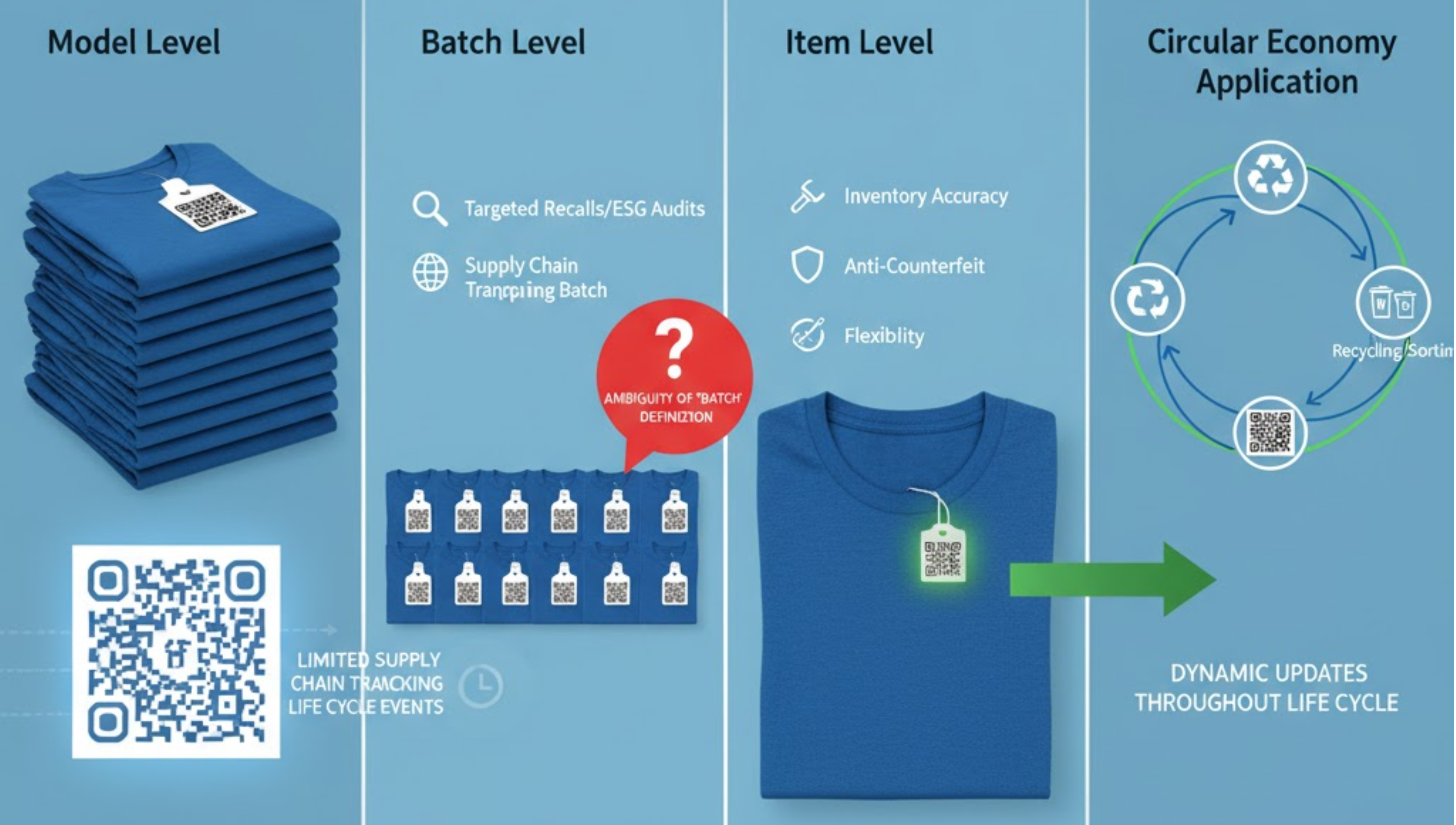
The move toward circularity in the textile and apparel industry is accelerating, driven by the planned introduction of the mandatory Digital Product Passport (DPP) under the ESPR (Ecodesign for Sustainable Products Regulation). A core question facing the industry—and the focus of a recent analysis by the CIRPASS-2 consortium—is determining the appropriate level of granularity for the DPP information: Model, Batch, or Item.
This analysis, prepared to inform the Ecodesign Forum discussion on a delegated act for textiles, highlighted the pros and cons of each level, offering vital recommendations for creating a flexible and future-proof DPP system.
Here are the key takeaways from the CIRPASS-2 analysis:
1. Model Level: Simple, but Limiting
The model level is the least demanding approach.
The Good:
• It requires lower investment in IT systems and infrastructure, making it easier for SMEs (which dominate the textile sector) to implement DPPs efficiently.
• It aligns with existing IT systems (like ERP) and current product labeling practices.
• It is the only suitable approach for e-commerce pre-purchase information, as customers cannot identify the exact physical item they will receive.
• Information like eco-labels, durability features, and washing instructions can be meaningfully captured at this level.
The Bad:
• Model-level identifiers severely limit supply chain transparency; for instance, the country of origin may only be represented as a list of possibilities if the model is produced in multiple locations.
• It is very difficult to integrate more granular data from later life cycle phases, such as repairs, reselling, or end-of-life management.
• For product recalls, model-level granularity prevents distinguishing between faulty and non-faulty items within the same model, often requiring the recall of all items, leading to unnecessary costs and logistical burdens.
2. Batch Level: Potential for Precision, Hindered by Ambiguity
Batch-level granularity offers increased precision compared to the model level, but implementation is complex.
The Good:
• Batch-level DPPs can capture specific ESG-related data points like production facilities, processes, and time, ensuring enhanced supply-chain transparency compared to the model level.
• This level enables targeted interventions, such as focused recalls and ESG audits, reducing inefficiency and waste.
• It drives technological readiness among value-chain partners by requiring more accurate and timely data.
The Bad:
• The single most difficult issue is the ambiguity of the “batch” definition. The term can be interpreted differently (ESPR batch, production batch, shipping batch), leading to inconsistencies in reporting and data management. Public authorities need to provide clear, enforceable definitions.
• Similar to the item level, batch-specific information is challenging for online selling, as consumers cannot be reliably informed about the specific batch they will purchase.
• In general, batch-level identifiers complicate production and distribution flexibility, particularly if labels are produced centrally and well in advance of garment manufacturing.
3. Item Level: Essential for Circular Economy Goals
Item-level granularity, where every single unit of a product is uniquely identifiable, offers the greatest utility, especially for future circular applications.
The Good:
• Item-level tracking is the most suitable approach for supporting Circular Economy (CE) objectives. It allows life cycle data (resell, repair, sorting, recycling events) to be dynamically updated after market launch and consumer purchase, supporting EPR policies and CE metrics.
• It is critical for high-value long-lifespan apparel products and ‘product-as-a-service’ models.
• It supports anti-counterfeit measures, ownership claims, and secure secondary-market circulation.
• Item-level identifiers do not introduce the complexity associated with batch-specific labels and enhance inventory accuracy and supply-chain operations.
• Many brands are already voluntarily adopting item-level identifiers (such as RFID) for internal business reasons, including improved inventory management.
The Bad:
• For online selling, item-specific data cannot be displayed reliably prior to purchase, potentially requiring a separate ‘online model-level DPP’.
• There is a lack of consensus among consortium partners regarding the costs: some suggest the marginal cost is negligible (around 3 to 5 USD per 1000 labels for serialization), while others warn that it could represent a « very significant increased cost ».
4. Key Recommendations for the Future of DPPs
The collaborative review by CIRPASS-2 partners resulted in several critical recommendations:
1. Separate Information from Identification (R1 & R6): It is vital to clearly distinguish between the mandatory information requirements of the DPP and the level of identifier granularity embedded in the data carrier. The system architecture must be designed to support different combinations of identifier granularity (item/batch) linked to model or batch-level information requirements.
2. Encourage Item-Level Identification (R2): Item-level product identification should be encouraged to anticipate the future expansion of DPPs and adopt broader Circular Economy practices. This maximizes the economic value enabled by the DPP, fostering green innovation and new business models.
3. Prefer Aggregation for Environmental Data (R5): Although it may seem counter-intuitive, model-level mandatory information granularity should be preferred for aggregated environmental impact data, such as the Product Environmental Footprint (PEF). This is because aggregated and averaged values are often considered more useful, precise, and practical than attempting to capture exact, specific data values for every individual item.
4. Support SMEs (R3): If item-level identifiers become mandatory, regulatory authorities should support SMEs with phased-in timelines and financial support mechanisms, given their dominance in the textile sector.
5. Standardize Batch Definitions (R4): Clear and standardized definitions for various types of batches (ESPR batch, production batch, shipping batch) must be introduced to avoid operational inefficiencies and inconsistencies in logistics and manufacturing, should batch-level identification be pursued.
Here you can find the full document: https://zenodo.org/records/17395423
The analysis prepared by the CIRPASS-2 consortium concluded that building a flexible Digital Product Passport (DPP) system requires clearly distinguishing between the mandatory granularity of the information requirements and the granularity of the product identifiers. Item-level product identification should be encouraged, as preparing for a serialized future maximizes the economic value enabled by the DPP and anticipates the adoption of broader Circular Economy practices. Conversely, for aggregated environmental impact data, such as the Product Environmental Footprint (PEF), model-level mandatory information granularity should be preferred because aggregated values are often considered more useful and practical. Furthermore, if batch-level identification is pursued, clear and standardized definitions for various batch types (ESPR batch, production batch, shipping batch) must be introduced to avoid operational inefficiencies in logistics and manufacturing. Ultimately, designing the DPP architecture to link information (model or batch level) to item-level identifiers provides the greatest flexibility and capacity to deliver maximum utility over time, particularly for critical circular economy applications






Laisser un commentaire